Kant's Critique of Pure Reason by Otfried Höffe
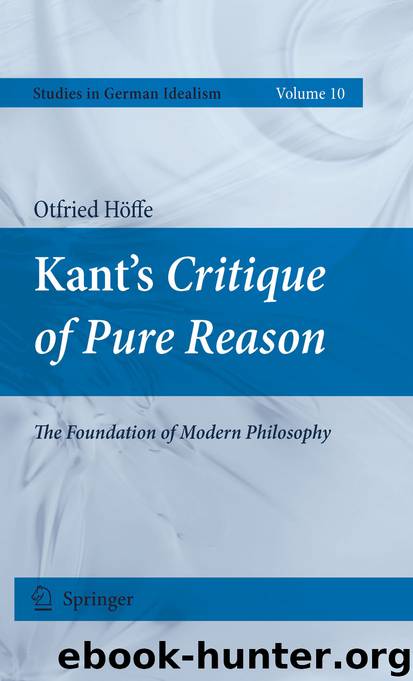
Author:Otfried Höffe
Language: eng
Format: epub
Publisher: Springer Netherlands, Dordrecht
We shall attempt to assess Kant’s general argument in two double steps: an examination of his critique of scepticism concerning the external world (15.1) and of his retrospective summary of the ‘Analytic’ (15.2); a discussion of the transcendental laws of nature with respect to mathematics (15.3) and the principle of causality (15.4).
15.1 Contra Scepticism concerning the External World
Ever since the early modern rediscovery of the sceptical tradition of classical thought, philosophers have engaged specifically with scepticism concerning the external world: with the question whether or how we are able to distinguish an objective external world from a subjectively dreamt or merely imagined world. Kant rejects the argumentation presented in exemplary form by Descartes in the Meditations, including the opening argument based on the cogito (I doubt, therefore I think, therefore I am) and the further crucial claims that the faculty of thought inhabits the body in an essentially external way and that there is a God who will not deceive us concerning the objective reality of the world. The alternative approach that is required, however, cannot consist in a ‘point by point’ refutation of scepticism concerning the external world or in some single claim or doctrine, but only in a complex network of arguments. In opposition to the realist approach that prevails in contemporary thought, this network of arguments, which constitutes transcendental idealism itself, offers a significant alternative model that has rarely received the full consideration it deserves:
(1) The Copernican Turn furnishes the substantive heart of the argument. Kant undertakes to prove the basic thesis that the external world can only be grasped as appearance rather than as a thing in itself (cf. A 369).
(2) In the context of appearances the external world is disclosed to us through outer sense. With respect to outer sense we must distinguish between space as the form of intuition and sensations as the content of intuition. The external world only acquires material content, in addition to mere spatiality, through the sensations furnished by the sense.
(3) It is quite true that Kant regards outer sense as primary. But if outer sense alone could guarantee the external world, we should expect the argument against scepticism with regard to the external world to be presented within the ‘Aesthetic’. Yet the relevant argument is only furnished later, long after the discussion of the theory of sensibility, namely towards the end of the ‘Analytic’ in the context of the postulates of empirical thought. The location of the argument itself indicates that Kant regards the doctrines elaborated after the ‘Aesthetic’ – the theory of the categories, of transcendental self-consciousness, of the schematism, of the principles, in short of the understanding and its a priori elements – as necessary components of the attempted refutation of scepticism concerning the external world. Such scepticism cannot properly be refuted by reference to sensibility alone, even with respect to its combination of empirical and pre-empirical aspects.
The relevant text, which Kant entitles ‘The Refutation of Idealism’ (B 274–9), represents Kant’s third formulation of the argument, after
Download
This site does not store any files on its server. We only index and link to content provided by other sites. Please contact the content providers to delete copyright contents if any and email us, we'll remove relevant links or contents immediately.
| Anthropology | Archaeology |
| Philosophy | Politics & Government |
| Social Sciences | Sociology |
| Women's Studies |
The remains of the day by Kazuo Ishiguro(8968)
Tools of Titans by Timothy Ferriss(8363)
Giovanni's Room by James Baldwin(7319)
The Black Swan by Nassim Nicholas Taleb(7103)
Inner Engineering: A Yogi's Guide to Joy by Sadhguru(6785)
The Way of Zen by Alan W. Watts(6594)
Asking the Right Questions: A Guide to Critical Thinking by M. Neil Browne & Stuart M. Keeley(5752)
The Power of Now: A Guide to Spiritual Enlightenment by Eckhart Tolle(5744)
The Six Wives Of Henry VIII (WOMEN IN HISTORY) by Fraser Antonia(5495)
Astrophysics for People in a Hurry by Neil DeGrasse Tyson(5174)
Housekeeping by Marilynne Robinson(4434)
12 Rules for Life by Jordan B. Peterson(4299)
Double Down (Diary of a Wimpy Kid Book 11) by Jeff Kinney(4257)
The Ethical Slut by Janet W. Hardy(4241)
Ikigai by Héctor García & Francesc Miralles(4237)
Skin in the Game by Nassim Nicholas Taleb(4235)
The Art of Happiness by The Dalai Lama(4120)
Skin in the Game: Hidden Asymmetries in Daily Life by Nassim Nicholas Taleb(3987)
Walking by Henry David Thoreau(3950)
